



Efficiency and Rapid Modernization for Government: AI Smart Support in Action
Real-world case studies and a repeatable model to deliver faster, smarter, and more accountable government services through the targeted use of AI.

Executive Summary
Governments are expected to deliver timely, effective public services—yet the systems that support these services often struggle with slow, manual processes, fragmented data, and high administrative costs. Across federal programs, inefficiencies continue to erode public confidence and fiscal responsibility. The Government Accountability Office (GAO) reported $162 billion in improper payments in 2024 - including payments to ineligible or deceased individuals - while broader estimates suggest fraud losses could reach $521 billion annually. These staggering losses not only undermine trust but divert resources from essential missions such as disaster recovery, public health, workforce development, and economic growth.
This challenge crosses party lines. A 2024 Pew Research study found that 56% of Americans believe the government is "almost always wasteful and inefficient." The demand for reform transcends politics, reflecting a national appetite for better, smarter, faster public systems built on accountability and results.
AI offers a transformative opportunity to close this gap. This paper outlines a pragmatic roadmap for public agencies to implement AI Smart Support—advancing from intelligent service matching and automated document processing to proactive outreach and risk detection. The result is faster decisions, greater equity, and measurable improvements across programs, drawing on real-world modernization examples and a proven, responsible implementation methodology.
The Problem: Bureaucratic Hurdles vs. Entrepreneurial Speed
The traditional model of public service delivery is often defined by three persistent obstacles:
- 1. Legacy Systems and Siloed Data: Critical information is trapped in outdated or disconnected systems, preventing a holistic view of individuals, cases, or program performance.
- 2. Manual-Intensive Workflows: From application intake to eligibility verification, manual processes are slow, error-prone, and consume valuable staff time.
- 3. Lack of Actionable Intelligence: Without predictive insights, agencies operate reactively. They cannot easily identify emerging needs, forecast demand, or proactively connect constituents with the right services.
Staffing shortages have further added to these constraints in recent years, forcing agencies to meet citizens’ needs with fewer hands on deck. For residents and service partners, this translates into long wait times, confusing processes, and inconsistent experiences. For agencies, it results in high operational costs, employee burnout, and challenges demonstrating meaningful outcomes.
The AI Smart Support Solution
There continues to be much discussion and misperceptions of AI in the media. Exactly how it can help agencies’ missions is often unclear. AI addresses the mentioned obstacles not by layering on more technology, but by redefining service delivery to become proactive, personalized, and predictive.
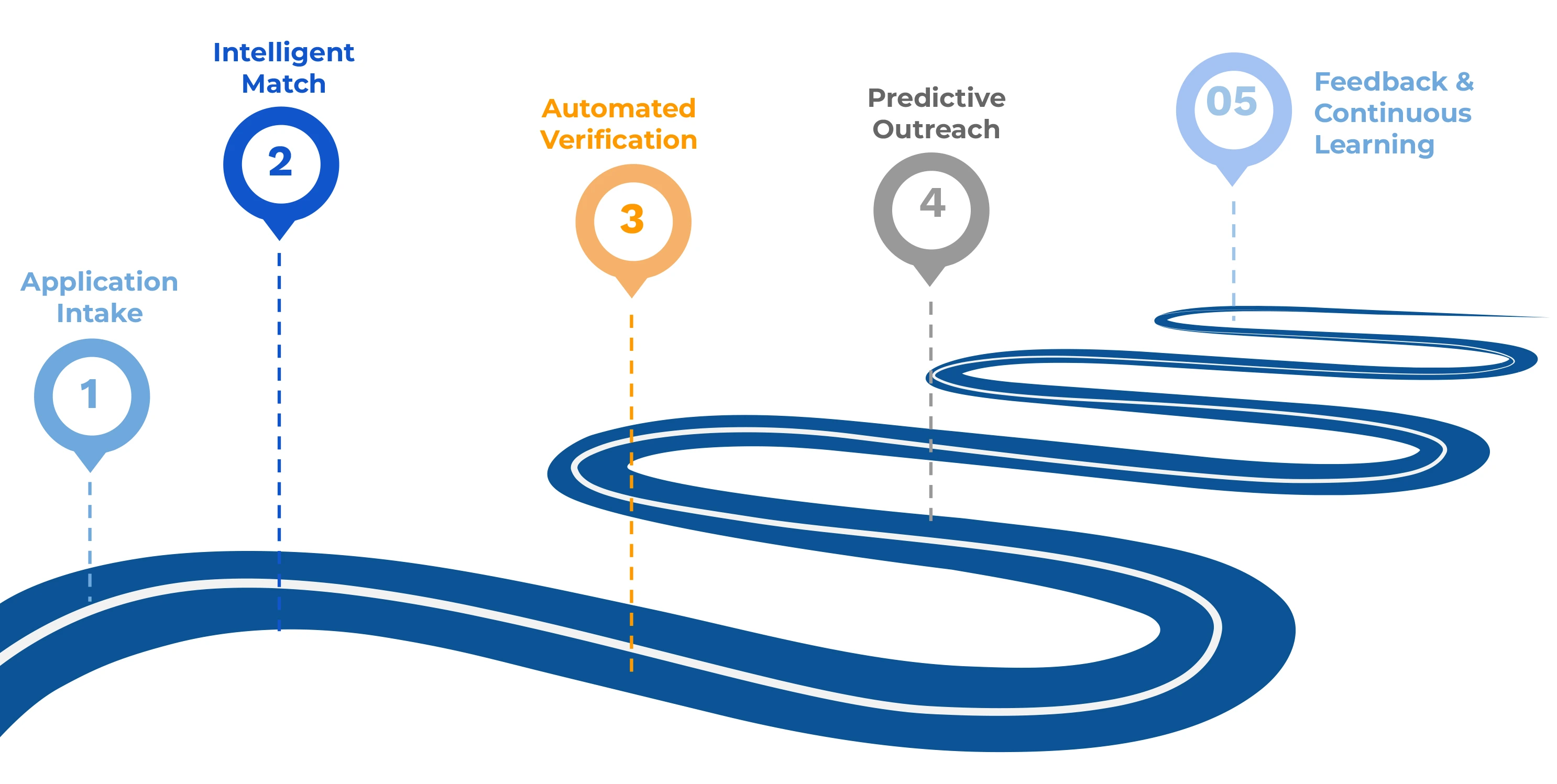
- Intelligent Matching: Instead of forcing the public to navigate a maze of programs, AI can instantly analyze an individual’s profile and match them to the most relevant services, complete with eligibility insights and preparation guidance.
- Automated Intake & Verification: Natural Language Processing (NLP) and computer vision can extract, validate, and summarize information from documents, pre-fill forms, flag inconsistencies, and greatly reduce processing time.
- Predictive Outreach & Risk Detection: AI models can identify emerging needs (e.g., spikes in health, housing, or workforce support demands) to enable proactive outreach. They can also flag anomalous patterns to support early detection of fraud or misuse of funds.
The key to all of these use cases for AI is that it does not supplant the human worker, but rather augments their capabilities. It can provide predictive information to a human to decide and act upon using their discretion, rather than simply executing it for the human. In this way, the human worker can be freed up to work more impactfully rather than being bogged down by research. When executed responsibly, this AI-driven approach yields faster decisions, higher throughput, fairer access, and stronger program integrity.
AI Smart Support Solution
A Proven Path: The Implementation Methodology
For agencies that are still working out the best AI use cases to open up to the public, there is another way AI can help agencies behind the scenes. By using AI in the modernization process itself, agencies can deliver value rapidly.
The following case studies were executed using the CardyWay Implementation Model, an AI-powered methodology designed for government programs. It ensures speed, certainty, and trust through four key elements:
- 1. Gap-Based Sprints: Launch a “Version 0” (v0) that meets ~70% of core needs, then close gaps through short, transparent sprint cycles.
- 2. Scenario Lens: Focus on real-world user scenarios and data-driven usage heat maps rather than exhaustive requirement lists.
- 3. GovTech PM Copilot: Provide leadership with an AI-driven, transparent view of real project progress and forward-looking analyses by integrating data from development tools.
- 4. AI Assistant for Audit & Validation: Allow leaders to query the system directly to verify progress, compliance, and adoption.
Real-World Outcomes in Public Service Modernization
This methodology has already delivered measurable results in complex government environments, proving that rapid, AI-enabled modernization is achievable.
Case Study: Department of Human Services, Georgia — Communicare Portal
- Challenge: Fragmented communication between caseworkers, foster parents, and volunteers was slowing down critical support for vulnerable children.
- Solution: A modular rollout of the Communicare portal using the CardyWay model.
- Outcome: A core communication application was live in just 4 months, facilitating real-time collaboration and faster response times. The agency now runs quarterly releases to continuously improve efficacy.
- Proof Point: This demonstrates that a focused, high-impact system can be deployed rapidly to improve service coordination.
Case Study: Department of Public Health, Georgia — Grants Management System
- Challenge: Inefficiencies in the application, review, and distribution of grants created delays and a lack of operational transparency.
- Solution: Deployment of a modern grants management system.
- Outcome: A base solution was deployed in 30 days. Through subsequent gap-based sprints, the agency addressed its specific needs and achieved a version 1.0 go-live in 8 months, streamlining the entire process for applicants and staff.
- Proof Point: This shows the model's effectiveness in automating and bringing transparency to complex application and review workflows, directly analogous to small business loan processing.
Case Study: San Mar Family & Community Services
- Challenge: The organization needed to streamline foster care referrals, improve data accuracy, and accelerate compliance reporting.
- Solution: Leveraged a pre-built foster care system v0 as a foundation and used gap-based sprints to address specific needs for digital licensing and referral management.
- Outcome: Successfully migrated, verified data, and went live in 6 months.
- Proof Point: This illustrates how a modular approach can be successfully applied to non-governmental entities that partner with the state, similar to how SBA partners with local lenders and advisors.
These outcomes reinforce that with the right approach, governments need not wait years for reform—they can achieve measurable improvements in months.
Governance & Trust: The Non-Negotiable Foundation
AI adoption in public programs must be built on a foundation of trust. Key principles include:
- Fairness & Bias Mitigation: Use representative data sets, monitor for disparate outcomes, and keep humans in the loop for final, high-stakes decisions.
- Transparency & Accountability: Ensure algorithms are explainable and provide clear reasoning for automated recommendations. Maintain robust audit trails.
- Privacy & Security: Adopt encryption, role-based access, and data-minimization principles from the outset.
- Continuous Monitoring: Regularly validate model performance against real-world outcomes and established governance frameworks like the NIST AI Risk Management Framework.
Recommendations for Agencies
- 1. Prioritize High-Impact Use Cases: Use a scenario-based discovery process to identify where AI can deliver the most immediate value, such as application triage or document verification.
- 2. Start with a Focused v0: Deliver a minimally viable product quickly to generate momentum and user feedback, rather than aiming for a "big bang" launch.
- 3. Embed Governance from Day One: Establish principles for fairness, accountability, and transparency before a single line of code is written.
- 4. Define and Track Meaningful KPIs: Measure success through metrics like time-to-decision, applicant satisfaction, equity of access, and fraud detection rates.
- 5. Invest in Organizational Readiness: Prepare staff through training and change management, positioning AI as a tool that augments their expertise and frees them from mundane tasks.
Conclusion
AI Smart Support represents a fundamental shift in public-sector efficiency. It transforms government systems from slow and reactive to intelligent, responsive, and equitable. The technology is ready, and the methodology has already proven its effectiveness across complex service environments.
With a responsible governance framework and a modular, outcome-focused delivery model, government programs can improve dramatically. In doing so, they can deliver the responsive, high-quality public services that residents and communities expect and deserve.
Cardinality.ai | www.cardyai.com
About the authors

Vishal Hanjan is the Chief Operating Officer at Cardinality.ai, where he is focused on helping government agencies deliver faster, smarter public services through AI-powered, modular platforms. Bringing over fifteen years of technology leadership to the role, Vishal is known for building high-performing teams, driving measurable growth, and creating go-to-market strategies that expand agency impact.
At Cardinality.ai, Vishal leads initiatives to modernize health and human services using collaborative, partner-first approaches and industry-leading SaaS transformation. His efforts have resulted in record-breaking service revenue and top recognition, such as the 2024 StateScoop 50 Industry Leadership Award. Vishal holds an MBA and a Master’s in Management from the University of Maryland, University College, and a Bachelor of Science in Biological Sciences from the University of Connecticut.
Committed to mentoring teams and embracing innovation, Vishal champions responsible AI solutions that empower government clients and strengthen outcomes for vulnerable communities.

Thank you for expressing your interest!
Your meeting is confirmed!