
+

ClearCycle is now part of Cardinality.ai
- Learn More



AI-Driven Information Retrieval for Government Agencies
Modernizing SLED Health and Human Services Systems through the CardyAI Virtual Assistant.

Government agencies, especially those in Health and Human Services (HHS), handle large amounts of case data, policies, and daily work information that support citizen services. However, old systems and separate databases make it hard to quickly find and share important data. This slows down decisions, reduces teamwork, and affects service quality.
Traditional search tools require users to move through many screens, enter exact keywords, and read long records to find what they need. Because of this, caseworkers and supervisors spend too much time searching for data instead of using it to help people.
Following federal guidance such as OMB Memorandum M-23-22, Executive Order 14110 on AI, and the HHS Trustworthy AI Playbook, this paper explains how AI-based tools can improve how government employees access and use data. Using AI-driven conversational search and natural language understanding (NLU), agencies can get faster and more accurate answers, save time, and make better decisions for the citizens they serve.
Problem Statement
Many state and local HHS agencies still use systems that are not connected. Staff must open multiple databases or ask reporting teams for help to get basic case details. This creates delays, adds work, and lowers overall productivity.
Key problems include:
- Slow access to data: Finding case details, policy rules, or upcoming tasks requires switching between different systems.
- Low self-sufficiency: Staff depend on reporting or IT teams for data retrieval.
- Workload visibility: Supervisors cannot easily see staff capacity or open caseloads.
Federal modernization rules (such as 45 CFR § 95, 42 CFR § 433, and 45 CFR § 1355) encourage agencies to adopt AI-enabled and interoperable systems that make data easier to share, improve accuracy, and support transparency.
Proposed Solution: AI-Driven Conversational Search
An AI-driven conversational assistant allows staff to ask natural questions and instantly get the right information from multiple systems. Examples include:
"What cases did I work on last week?"
"What are my top priorities today?"
"Prepare my travel plan for this week."
"Which team members have the most open cases?"
This approach replaces manual searches with instant, context-based responses, improving both speed and accuracy.
Background
Cardinality’s CardyAI Virtual Assistant helps government agencies manage and access information using AI and automation. In states like Georgia, Wyoming, and Indiana, the CardyAI Assistant has helped caseworkers and supervisors get real-time insights, manage workloads, and make informed decisions.
Using Conversational AI, Machine Learning (ML), and Natural Language Processing (NLP), CardyAI connects old systems and new AI tools. Caseworkers can simply ask, “Show me my open cases” or “What policy applies to kinship care?” and receive clear answers immediately.
This supports state and federal goals for modernization, accountability, and efficiency.
Key Goals and Objectives
- Enable Instant information access: Retrieve case data, reports, and policies using plain-language questions.
- Remove manual searches: Find key information quickly without switching between systems.
- Speed up knowledge discovery: Use OCR and text analytics to summarize policies and documents automatically.`
Core Technologies Behind CardyAI
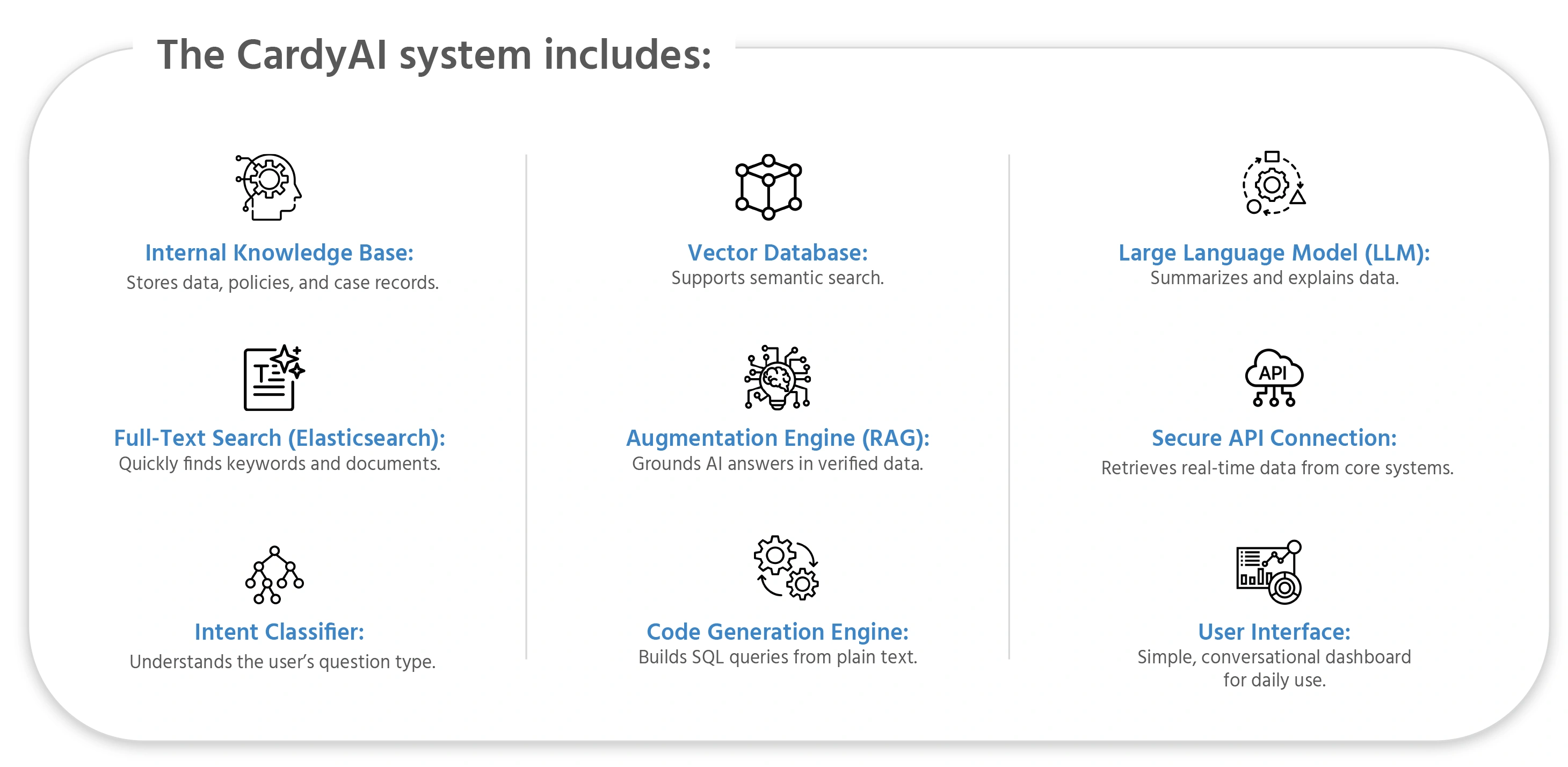
1. Retrieval-Augmented Generation (RAG)
Combines search with summarization, letting staff get quick, correct answers from both structured and unstructured data. This supports data-sharing and traceability rules under 45 CFR § 1355.52.
2. Embedding Models for Semantic Search
Helps find information by meaning, not exact words. For example, “Show adoption policies related to kinship care” returns the right content even if the exact words differ. This supports HHS Data Strategy 2023–2026.
3. Large Language Models (LLMs)
LLMs like Mistral-7B can summarize, explain, or generate simple answers from complex documents. This supports the Executive Order 14110 requirement for clear, safe, and explainable AI.
4. AI-Powered SQL Generation
Allows non-technical staff to ask questions in natural language. For example:
“Show the number of overdue investigations by county this month.”
The assistant turns this into a database query and shows the results.
This follows 42 CFR § 433.112 and 45 CFR § 95.626 for modular and interoperable systems.
Architecture Overview
Recommendations for SLED HHS Systems
To meet modernization goals, state and local agencies should use AI-enabled, unified architectures that improve data sharing and compliance.
System-Level Recommendations
1. Child Welfare (CCWIS)
- Use AI to validate data and retrieve placement history.
- Support outcome-based tracking per FFPSA.
2. Integrated Eligibility (IES)
- Use conversational AI for eligibility across SNAP, TANF, and Medicaid.
- Follow IRS Pub 1075 for data protection.
3. Medicaid (MES/MMIS)
- Add AI for provider validation and fraud detection.
- Support compliance with NIST 800-53, MARS-E 2.0, and HIPAA.
4. Child Care Systems
- Use AI to classify documents and verify compliance.
- Enable data sharing with IES and CCWIS.
5. Child Support Enforcement
- Use AI matching for income and paternity records.
- Automate reporting per OCSE 34A/157.
6. Public Safety Systems
- Use AI to retrieve criminal and behavioral health data.
- Maintain CJIS-compliant data access.
Governance and Leadership
Leaders should:
- Form statewide AI governance boards under HHS and NIST AI RMF 1.0.
- Create data governance frameworks following OMB A-130 and HHS Data Strategy 2023–2026
- Work with federal partners (ACF, CMS, OCSE, FNS) for data standards reuse.
- Ensure responsible AI use, including transparency, fairness, and bias checks.
Conclusion
By adopting AI-driven retrieval systems that follow federal rules and modernization goals, agencies can:
- Improve efficiency through automation.
- Increase transparency and program compliance.
- Strengthen citizen outcomes through connected, data-driven decisions.
The CardyAI Assistant shows how AI can help government agencies access and use data faster, reduce manual work, and support federal goals for modernization, accountability, and better service delivery.
Cardinality.ai | www.cardyai.com
About the authors

Kevin Jones is the Chief Strategy Officer at Cardinality.ai and a former Chief Information Officer for the Indiana Department of Child Services. With over two decades of experience in public sector technology and leadership, he focuses on driving digital transformation to strengthen human services delivery and improve outcomes for vulnerable communities.

Thank you for expressing your interest!
Your meeting is confirmed!